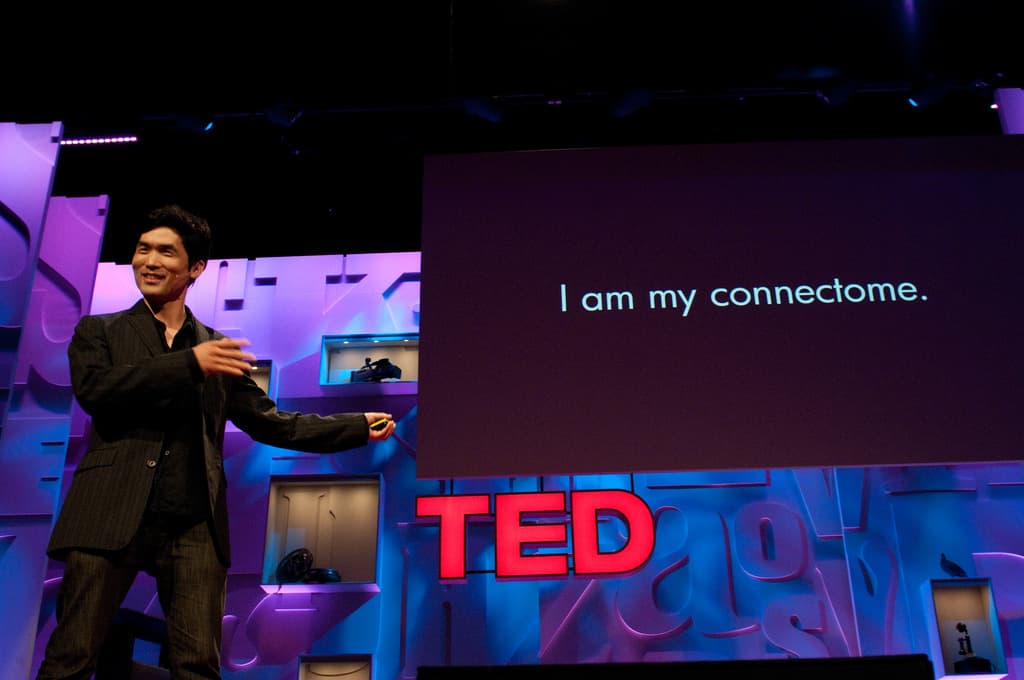
我就是我的连接组——塞巴斯蒂安 talk at TED in 2010年9月29日
我给这本书评分较低的原因是我觉得这本书充斥着“空谈”(Seung 的 TED 演讲也让我想到了这一点)。作为一名生物信息学家,我理解当时围绕人类基因组计划的炒作。我们用不到一年的工资就能对一个人进行测序,但并非所有遗传疾病都已从地球上消失。同样,Seung 也没有深入探讨我们将如何利用连接组来读取记忆或治疗抑郁症。
所以非常有趣,一个生物信息学家批评承现峻,太过于浮夸了。还有ta提到了关于能不能用连接组找到治疗抑郁症的方法。我觉得肯定不行的。因为连接组只是神经连接结构,structures。而实际上影响神经活动的还有神经递质,离子,这些代谢,在分子水平的运动。说实话我主要只对神经突触的可塑性感兴趣,我们如何重塑我们的神经突触,这样子我们也许可以修复一些连接上的缺陷。但是显然我们还没有那种想法——》神经结构改变 的一种科学的发现。所以我觉得不能宣称,某种思想方式,或者某种思想内容,就对于治疗神经疾病有作用。像市面上宣称的冥想,还有就是正念冥想。以及认知行为治疗。这些我觉得他们都没有逆向的可以证明对神经系统的治疗与改良作用的科学证据的,大部分都是自己宣称自己有用。和我在某些网络平台上看有的人,双相刚刚从抑郁期过度到轻躁狂,ta们就觉得自己某种做法“有用”,可以不吃药,自愈!这是很幼稚的和不科学的说法与提法。其实这个生物信息学家说从连接组里面找到治疗抑郁症的方法,也是我当初研究双向情感障碍的脑神经结构的想法。但是既然还有那么多神经递质内分泌的生化代谢,这个问题变得特别的复杂。所以单一的结构性的研究不可能解决这个问题。而且考虑到神经递质的分子代谢,那么承所谓“连接组决定了我们是什么人”就要打50%的折扣了。因为连接组是结构,那你还有代谢。人活着的一刻,就会有代谢。所以我想也许我还要看一些关于精神疾病的神经递质代谢与内分泌的科学研究。光是这个连接组是不靠谱的。而且承作为连接组的,又引入什么心理学棍的观念,后天生活可以影响连接组。这个就是打算把人格发育与连接组(神经系统)的发育给联系起来了。但是大脑在25岁发育基本完成,这就有点惨了。特别是对于认知行为治疗来说,脑壳固定了,你左想右想,脑子的连接组和神经结构估计都很难改了。所以实际上就都是复杂问题。脑科学的,内分泌代谢的,以及社会环境与生活经历与神经系统互作的,(想法与神经结构和神经代谢的关系问题)。这些问题都是很复杂的,恐怕不是在100年内能够获得比较清楚和系统性答案的。还是药物,药物会比较现实一些。经过大规模的人肉试药。因为结构性的改变不可能拿活人做实验。当然现在的磁刺激治疗也是拿活人做实验。还有电击疗法。他们认为可以产生比较大规模的结构变化,这点我还是持怀疑态度。神经突触可塑性,这个概念很好,但是具体如何塑造,则太难琢磨了。
如下是演讲正文:
我们生活在一个非凡的时代——基因组时代。你的基因组是你的DNA完整序列。我的序列和你的略有不同,这就是为什么我们长得不一样。我有棕色的眼睛,你可能有蓝色或灰色的。但这不仅仅是表面现象。新闻头条告诉我们,基因可能导致可怕的疾病,甚至塑造我们的个性,或者引发精神障碍。我们的基因似乎对我们的命运有巨大的影响力。然而,我想认为我不仅仅是我的基因。你们怎么看?你们认为自己超越了自己的基因吗?(观众:是的。)是的?我觉得有些人同意我的看法。我认为我们应该发表一个声明,一起说出来。好吧:“我超越了我的基因”——大家一起说。所有人:我超越了我的基因。(欢呼)
塞巴斯蒂安· Seung:我是什么?(笑声)我是我的连接组。现在,既然你们这么棒,也许可以再配合我一下,一起说这个。(笑声)好吧,大家一起说。所有人:我是我的连接组。Seung:听起来太棒了。你们真是太好了,连什么是连接组都不知道,还愿意跟我一起玩。我现在都可以回家了。
目前,只有一个已知的连接组,那就是这个小虫子。它的神经系统非常简单,只有300个神经元。在1970年代和1980年代,一组科学家绘制了所有7000个神经元之间的连接。在这个图表中,每个节点是一个神经元,每条线是一个连接。这是秀丽隐杆线虫的连接组。你的连接组远比这个复杂,因为你的大脑有1000亿个神经元,以及多达10,000倍的连接。你的脑子里也有这样的图表,但它绝对放不进这个幻灯片。你的连接组包含的连接比你的基因组的字母多一百万倍。那是海量的信息。
这些信息里有什么?我们还不确定,但有一些理论。从19世纪开始,神经科学家们推测,也许你的记忆——那些让你成为你的信息——可能存储在你大脑神经元之间的连接中。也许你的个人身份的其他方面——比如你的个性和智力——也可能编码在神经元之间的连接中。所以,你现在明白我为什么提出这个假设:我是我的连接组。我不是让你们喊这个因为它是真的;我只是想让你们记住它。事实上,我们不知道这个假设是否正确,因为我们从未拥有足够强大的技术来验证它。找到那个线虫的连接组花了十几年的繁琐工作。要找到像我们这样的大脑的连接组,我们需要更先进的技术,自动化的技术,以加速寻找连接组的过程。在接下来的几分钟里,我将向你们介绍一些正在我和其他合作者实验室中开发的技术。
你可能见过神经元的图片。你可以立刻认出它们,因为它们有着奇妙的形状。它们延伸出长而纤细的分支,简而言之,它们看起来像树。但这只是单个神经元。为了找到连接组,我们必须同时看到所有神经元。所以,让我们认识一下在哈佛大学Jeff Lichtman实验室工作的Bobby Kasthuri。Bobby正拿着非常薄的鼠标大脑切片。我们放大了100,000倍以获得分辨率,这样我们就能同时看到神经元的分支。只是,你可能还是认不出来,因为我们必须在三维空间中工作。
如果我们拍摄许多大脑切片的图像并将它们堆叠起来,我们就能得到一个三维图像。你可能还是看不到分支。所以我们从顶部开始,将一个分支的横截面涂成红色,然后对下一个切片再做同样的事,依次进行。如果我们继续处理整个堆栈,我们就可以重建一个神经元分支小片段的三维形状。我们也可以为另一个神经元用绿色做同样的事。你可以看到绿色神经元在两个位置接触红色神经元,这些位置被称为突触。
让我们放大一个突触,注意绿色神经元内部。你应该能看到小圆圈——这些被称为囊泡。它们含有一种叫做神经递质的分子。当绿色神经元想交流,想向红色神经元发送信息时,它会释放神经递质。在突触处,这两个神经元被认为是通过连接的,就像两个朋友在电话上交谈。
所以,你知道如何找到一个突触了。我们如何找到整个连接组呢?我们将这个三维图像堆栈当作一个巨大的三维涂色书。我们将每个神经元涂上不同的颜色,然后浏览所有图像,找到突触并记录涉及的两个神经元的颜色。如果我们能在所有图像中做到这一点,我们就能找到一个连接组。
现在,你已经了解了神经元和突触的基础知识。所以,我想我们准备好应对神经科学中最重要的问题之一了:男性和女性的大脑有何不同?(笑声)根据这本自助书,男人的大脑像华夫饼,他们把生活分成一个个格子。女人的大脑像意大利面,生活中一切都与其他一切相连。(笑声)你们在笑,但你们知道,这本书改变了我的人生。(笑声)但说真的,这有什么问题?你已经知道足够多的知识来告诉我——这个说法有什么问题?不管你是男是女,每个人的大脑都像意大利面。或者更确切地说,是非常非常细的卡佩里尼面,带着分支。就像盘子里的一根意大利面接触到许多其他面条,一个神经元通过它们纠缠的分支接触到许多其他神经元。一个神经元可以连接到如此多的其他神经元,因为在这些接触点可以有突触。到现在,你可能已经有点迷失了这个脑组织的立方体到底有多大。
所以,让我们做一系列比较来展示。我向你保证,这非常小。它的边长只有6微米。这是一个神经元的大小比较。你可以看出,真的只有最小的分支片段包含在这个立方体中。而一个神经元,比大脑小得多。这只是一个老鼠的大脑——比人类的大脑小得多。所以当我向朋友们展示这个时,他们有时候会说:“你知道,Sebastian,你应该放弃。神经科学毫无希望。”因为如果你用肉眼看大脑,你不会真正看到它有多复杂,但当你用显微镜看时,隐藏的复杂性终于显现出来。
在17世纪,数学家和哲学家布莱兹·帕斯卡写道,他对无限的恐惧,他在思考外太空的广阔时感到自己的渺小。作为一个科学家,我不应该谈论我的感受——太多的信息了,教授。(笑声)但我可以吗?(笑声)(掌声)我感到好奇,我感到惊奇,但有时候我也感到绝望。为什么我要选择研究这个复杂得几乎可能是无限的器官?太离谱了。我们怎么敢认为我们能理解它?
然而,我坚持在这场堂吉诃德式的努力中。如今,我怀抱新的希望。有一天,一群显微镜将捕捉每一个神经元和每一个突触,存储在一个巨大的图像数据库中。有一天,人工智能超级计算机将无需人工辅助分析图像,总结出一个连接组。我不知道,但我希望我能活到那一天,因为找到一个完整的人类连接组是有史以来最大的技术挑战之一。这需要几代人的努力才能成功。目前,我和我的合作者的目标要谦虚得多——只是找到小块老鼠和人类大脑的部分连接组。但即便如此,这也足以进行第一次测试这个假设:我是我的连接组。现在,让我试着说服你这个假设的可信度,值得我们认真对待。
在你童年成长和成年衰老的过程中,你的个人身份缓慢变化。同样,每个连接组也会随时间变化。发生什么样的变化呢?神经元像树一样,可以长出新的分支,也可能失去旧的分支。突触可以生成,也可能被消除。突触可以变大,也可以变小。第二个问题:是什么引起这些变化?是的,确实,在某种程度上,它们是由你的基因编程的。但这不是全部。因为有信号,电信号,沿着神经元的分支传播,还有化学信号,从一个分支跳到另一个分支。这些信号被称为神经活动。有很多证据表明,神经活动正在编码我们的思想、感情和感知,我们的心理体验。有很多证据表明,神经活动可以改变你的连接。如果你把这两个事实结合起来,就意味着你的经历可以改变你的连接组。这就是为什么每个连接组都是独一的,即使是基因相同的双胞胎也是如此。连接组是自然与遗传的交汇处。甚至可能仅仅是你思考的行为就能改变你的连接组——这个想法可能让你感到振奋。
这张图片里有什么?你说这是一个凉爽清新的水流。还有什么?别忘了那个被称为河床的地球上的凹槽。没有它,水流就不知道往哪个方向流。有了这个水流,我想提出一个关于神经活动和连接性的比喻。神经活动不断变化,就像河流的水,永不停歇。大脑的神经网络连接决定了神经活动流动的路径。所以,连接组就像河床;但这个比喻更丰富,因为确实,河床引导水流,但长期来看,水流也重塑了河床。正如我刚告诉你的,神经活动可以改变连接组。如果你允许我上升到隐喻的高度,我会提醒你,神经活动是思想、感情和感知的物理基础——神经科学家是这么想的。所以我们甚至可以说意识之流。神经活动是它的水,连接组是它的床。
让我们从隐喻的高度回到科学。假设我们寻找连接组的技术真的有效。我们将如何测试“我是我的连接组”这个假设?我提出一个直接的测试。让我们尝试从连接组中读取记忆。考虑长时间序列的运动的记忆,比如一个钢琴家演奏贝多芬奏鸣曲。根据19世纪的理论,这种记忆存储在你脑内的突触连接链中。因为,如果链中的第一个神经元被激活,通过它们的突触,它们向第二个神经元发送信息,依次激活,就像一串倒下的多米诺骨牌。这个神经激活序列被假设是那些运动序列的神经基础。
所以,测试这个理论的一个方法是在连接组中寻找这种链。但这不会简单。它们不会像这样整齐。它们会被打乱。所以我们必须使用计算机来尝试解开这个链。如果我们能做到这一点,我们从解开中恢复的神经元序列将是对记忆回忆期间在大脑中重播的神经活动模式的预测。如果这成功了,那将是第一个从连接组中读取记忆的例子。
(笑声)多乱啊——你有没有试过接线一个像这样复杂的系统?我希望没有。但如果你试过,你知道很容易出错。神经元的分支就像大脑的电线。有人能猜猜:你脑子里电线的总长度是多少?我给你一个提示。这是一个很大的数字。(笑声)我估计,有几百万英里,全都塞在你的头颅里。如果你能领会这个数字,你就很容易看出,大脑的错误接线有巨大的潜力。确实,大众媒体喜欢这样的标题:“厌食症患者的大脑的接线不同,”或“自闭症患者的大脑的接线不同。”这些是合理的说法,但事实上,我们还不能清楚地看到大脑的接线,无法确定这些是否真的。连接组的看到连接组的技术将使我们最终能读取大脑的错误接线,在连接组中看到精神障碍。
有时候,测试一个假设的最佳方法是考虑它最极端的含义。如果你相信我是我的连接组,我想你也必须接受死亡是你的连接组被摧毁的观点。我提到这个,因为今天有先知声称,技术将从根本上改变人类状况,甚至可能改变人类物种。他们最珍视的梦想之一是通过被称为冷冻学的做法来欺骗死亡。如果你支付10万美元,你可以安排在死后将你的身体冷冻,储存在亚利桑那州的一个仓库的液氮中,等待一个先进的未来文明复活你。
我们应该嘲笑这些现代的永生追求者,称他们为傻瓜吗?还是他们有一天会在我们的坟墓上轻笑?我不知道——我想通过科学测试他们的信念。我建议我们尝试找到一个冷冻大脑的连接组。我们知道死后和冷冻过程中大脑会受损。问题是:这种损害是否抹去了连接组?如果是这样,任何未来文明都不可能恢复这些冷冻大脑的记忆。复活可能对身体成功,但对心智不行。另一方面,如果连接组仍然完好,我们就不能轻易嘲笑冷冻学的说法。
我描述了一个从微小世界开始,推向遥远未来的探索。连接组将标志着人类历史的一个转折点。当我们从非洲大草原上的类猿祖先进化时,区别我们的是我们更大的大脑。我们用我们的大脑创造了越来越惊艳的技术。最终,这些技术将变得如此强大,我们将用它们通过解构和重构我们自己的大脑来认识自己。我相信,这场自我发现之旅不仅是科学家的,也是我们所有人的。今天我很感激能与你们分享这段旅程。
谢谢!
(掌声)
如下是英文版讲稿
We live in a remarkable time. The age of genomics. Your genome is the entire sequence of your DNA. Your sequence and mine are slightly different. That's why we look different. I've got brown eyes. You might have blue or gray. But it's not just skin-deep. The headlines tell us that genes can give us scary diseases. Maybe even shape our personality. Or give us mental disorders. Our genes seem to have awesome power over our destinies. And yet, I would like to think that I am more than my genes. What do you guys think? Are you more than your genes? (Audience: Yes.) Yes? I think some people agree with me. I think we should make a statement. I think we should say it all together. All right: "I'm more than my genes" — all together. Everybody: I am more than my genes. (Cheering)
Sebastian Seung: What am I? (Laughter) I am my connectome. Now, since you guys are really great, maybe you can humor me and say this all together too. (Laughter) Right. All together now. Everybody: I am my connectome. SS: That sounded great. You know, you guys are so great. You don't even know what a connectome is, and you're willing to play along with me. I could just go home now.
Well, so far only one connectome is known. That of this tiny worm. Its modest nervous system consists of just 300 neurons. And in the 1970s and '80s, a team of scientists mapped all 7,000 connections between the neurons. In this diagram, every node is a neuron. And every line is a connection. This is the connectome of the worm C. elegans. Your connectome is far more complex than this. Because your brain contains 100 billion neurons. And 10,000 times as many connections. There's a diagram like this for your brain. But there's no way it would fit on this slide. Your connectome contains one million times more connections than your genome has letters. That's a lot of information.
What's in that information? We don't know for sure. But there are theories. Since the 19th century, neuroscientists have speculated that maybe your memories — the information that makes you, you — maybe your memories are stored in the connections between your brain's neurons. And perhaps other aspects of your personal identity — maybe your personality and your intellect — maybe they're also encoded in the connections between your neurons. And so now you can see why I proposed this hypothesis: I am my connectome. I didn't ask you to chant it because it's true. I just want you to remember it. And in fact, we don't know if this hypothesis is correct. Because we have never had technologies powerful enough to test it. Finding that worm connectome took over a dozen years of tedious labor. And to find the connectomes of brains more like our own, we need more sophisticated technologies. That are automated. That will speed up the process of finding connectomes. And in the next few minutes, I'll tell you about some of these technologies. Which are currently under development in my lab and the labs of my collaborators.
Now you've probably seen pictures of neurons before. You can recognize them instantly by their fantastic shapes. They extend long and delicate branches. And in short, they look like trees. But this is just a single neuron. In order to find connectomes, we have to see all the neurons at the same time. So let's meet Bobby Kasthuri. Who works in the laboratory of Jeff Lichtman at Harvard University. Bobby is holding fantastically thin slices of a mouse brain. And we're zooming in by a factor of 100,000 times to obtain the resolution. So that we can see the branches of neurons all at the same time. Except, you still may not really recognize them. And that's because we have to work in three dimensions.
If we take many images of many slices of the brain and stack them up, we get a three-dimensional image. And still, you may not see the branches. So we start at the top. And we color in the cross-section of one branch in red. And we do that for the next slice and for the next slice. And we keep on doing that, slice after slice. If we continue through the entire stack, we can reconstruct the three-dimensional shape of a small fragment of a branch of a neuron. And we can do that for another neuron in green. And you can see that the green neuron touches the red neuron at two locations. And these are what are called synapses.
Let's zoom in on one synapse. And keep your eyes on the interior of the green neuron. You should see small circles — these are called vesicles. They contain a molecule known as a neurotransmitter. And so when the green neuron wants to communicate, it wants to send a message to the red neuron. It spits out neurotransmitter. At the synapse, the two neurons are said to be connected. Like two friends talking on the telephone.
So you see how to find a synapse. How can we find an entire connectome? Well, we take this three-dimensional stack of images. And treat it as a gigantic three-dimensional coloring book. We color every neuron in, in a different color. And then we look through all of the images. Find the synapses and note the colors of the two neurons involved in each synapse. If we can do that throughout all the images, we could find a connectome.
Now, at this point, you've learned the basics of neurons and synapses. And so I think we're ready to tackle one of the most important questions in neuroscience. How are the brains of men and women different? (Laughter) According to this self-help book, guys' brains are like waffles. They keep their lives compartmentalized in boxes. Girls' brains are like spaghetti. Everything in their life is connected to everything else. (Laughter) You guys are laughing. But you know, this book changed my life. (Laughter) But seriously, what's wrong with this? You already know enough to tell me — what's wrong with this statement? It doesn't matter whether you're a guy or girl. Everyone's brains are like spaghetti. Or maybe really, really fine capellini with branches. Just as one strand of spaghetti contacts many other strands on your plate, one neuron touches many other neurons through their entangled branches. One neuron can be connected to so many other neurons. Because there can be synapses at these points of contact.
By now, you might have sort of lost perspective on how large this cube of brain tissue actually is. And so let's do a series of comparisons to show you. I assure you, this is very tiny. It's just six microns on a side. So, here's how it stacks up against an entire neuron. And you can tell that, really, only the smallest fragments of branches are contained inside this cube. And a neuron, well, that's smaller than a brain. And that's just a mouse brain — it's a lot smaller than a human brain. So when I show my friends this, sometimes they've told me, "You know, Sebastian, you should just give up. Neuroscience is hopeless." Because if you look at a brain with your naked eye, you don't really see how complex it is. But when you use a microscope, finally the hidden complexity is revealed.
In the 17th century, the mathematician and philosopher, Blaise Pascal, wrote of his dread of the infinite. His feeling of insignificance at contemplating the vast reaches of outer space. And, as a scientist, I'm not supposed to talk about my feelings — too much information, professor. (Laughter) But may I? (Laughter) (Applause) I feel curiosity. And I feel wonder. But at times I have also felt despair. Why did I choose to study this organ that is so awesome in its complexity that it might well be infinite? It's absurd. How could we even dare to think that we might ever understand this?
And yet, I persist in this quixotic endeavor. And indeed, these days I harbor new hopes. Someday, a fleet of microscopes will capture every neuron and every synapse in a vast database of images. And someday, artificially intelligent supercomputers will analyze the images without human assistance to summarize them in a connectome. I do not know. But I hope that I will live to see that day. Because finding an entire human connectome is one of the greatest technological challenges of all time. It will take the work of generations to succeed. At the present time, my collaborators and I, what we're aiming for is much more modest. Just to find partial connectomes of tiny chunks of mouse and human brain. But even that will be enough for the first tests of this hypothesis that I am my connectome.
For now, let me try to convince you of the plausibility of this hypothesis. That it's actually worth taking seriously. As you grow during childhood and age during adulthood, your personal identity changes slowly. Likewise, every connectome changes over time. What kinds of changes happen? Well, neurons, like trees, can grow new branches. And they can lose old ones. Synapses can be created. And they can be eliminated. And synapses can grow larger. And they can grow smaller.
Second question: what causes these changes? Well, it's true. To some extent, they are programmed by your genes. But that's not the whole story. Because there are signals, electrical signals, that travel along the branches of neurons. And chemical signals that jump across from branch to branch. These signals are called neural activity. And there's a lot of evidence that neural activity is encoding our thoughts, feelings, and perceptions. Our mental experiences. And there's a lot of evidence that neural activity can cause your connections to change. And if you put those two facts together, it means that your experiences can change your connectome. And that's why every connectome is unique. Even those of genetically identical twins. The connectome is where nature meets nurture. And it might be true that just the mere act of thinking can change your connectome. An idea that you may find empowering.
What's in this picture? A cool and refreshing stream of water, you say. What else is in this picture? Do not forget that groove in the Earth called the stream bed. Without it, the water would not know in which direction to flow. And with the stream, I would like to propose a metaphor for the relationship between neural activity and connectivity. Neural activity is constantly changing. It's like the water of the stream. It never sits still. The connections of the brain's neural network determine the pathways along which neural activity flows. And so the connectome is like the bed of the stream. But the metaphor is richer than that. Because it's true that the stream bed guides the flow of the water. But over long timescales, the water also reshapes the bed of the stream. And as I told you just now, neural activity can change the connectome. And if you'll allow me to ascend to metaphorical heights, I will remind you that neural activity is the physical basis — or so neuroscientists think — of thoughts, feelings, and perceptions. And so we might even speak of the stream of consciousness. Neural activity is its water. And the connectome is its bed.
So let's return from the heights of metaphor and return to science. Suppose our technologies for finding connectomes actually work. How will we go about testing the hypothesis "I am my connectome"? Well, I propose a direct test. Let us attempt to read out memories from connectomes. Consider the memory of long temporal sequences of movements. Like a pianist playing a Beethoven sonata. According to a theory that dates back to the 19th century, such memories are stored as chains of synaptic connections inside your brain. Because, if the first neurons in the chain are activated, through their synapses they send messages to the second neurons. Which are activated. And so on down the line. Like a chain of falling dominoes. And this sequence of neural activation is hypothesized to be the neural basis of those sequences of movements.
So one way of trying to test the theory is to look for such chains inside connectomes. But it won't be easy. Because they're not going to look like this. They're going to be scrambled up. So we'll have to use our computers to try to unscramble the chain. And if we can do that, the sequence of the neurons we recover from that unscrambling will be a prediction of the pattern of neural activity that is replayed in the brain during memory recall. And if that were successful, that would be the first example of reading a memory from a connectome.
(Laughter) What a mess — have you ever tried to wire up a system as complex as this? I hope not. But if you have, you know it's very easy to make a mistake. The branches of neurons are like the wires of the brain. Can anyone guess: what's the total length of wires in your brain? I'll give you a hint. It's a big number. (Laughter) I estimate, millions of miles. All packed in your skull. And if you appreciate that number, you can easily see there is huge potential for mis-wiring of the brain. And indeed, the popular press loves headlines like, "Anorexic brains are wired differently." Or "Autistic brains are wired differently." These are plausible claims. But in truth, we can't see the brain's wiring clearly enough to tell if these are really true. And so the technologies for seeing connectomes will allow us to finally read mis-wiring of the brain. To see mental disorders in connectomes.
Sometimes the best way to test a hypothesis is to consider its most extreme implication. Philosophers know this game very well. If you believe that I am my connectome, I think you must also accept the idea that death is the destruction of your connectome. I mention this because there are prophets today who claim that technology will fundamentally alter the human condition. And perhaps even transform the human species. One of their most cherished dreams is to cheat death by that practice known as cryonics. If you pay 100,000 dollars, you can arrange to have your body frozen after death. And stored in liquid nitrogen in one of these tanks in an Arizona warehouse. Awaiting a future civilization that is advanced to resurrect you.
Should we ridicule the modern seekers of immortality? Calling them fools? Or will they someday chuckle over our graves? I don't know — I prefer to test their beliefs, scientifically. I propose that we attempt to find a connectome of a frozen brain. We know that damage to the brain occurs after death and during freezing. The question is: has that damage erased the connectome? If it has, there is no way that any future civilization will be able to recover the memories of these frozen brains. Resurrection might succeed for the body. But not for the mind. On the other hand, if the connectome is still intact, we cannot ridicule the claims of cryonics so easily.
I've described a quest that begins in the world of the very small. And propels us to the world of the far future. Connectomes will mark a turning point in human history. As we evolved from our ape-like ancestors on the African savanna, what distinguished us was our larger brains. We have used our brains to fashion ever more amazing technologies. Eventually, these technologies will become so powerful that we will use them to know ourselves. By deconstructing and reconstructing our own brains. I believe that this voyage of self-discovery is not just for scientists. But for all of us. And I'm grateful for the opportunity to share this voyage with you today.
Thank you. (Applause)