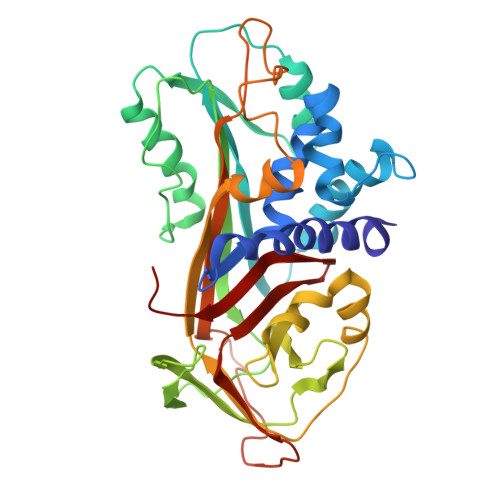
P01009
A1AT_HUMANSERPINA1
Alpha-1-antitrypsin
Homo sapiensTaxon: 9606
3D-structureAcute phaseAlternative splicingBlood coagulationDirect protein sequencingEndoplasmic reticulumExtracellular matrixGlycoproteinHemostasisPhosphoproteinProtease inhibitorProteomics identification+4
Longueur de Séquence
418
acides aminés
Poids Moléculaire
46.7 kDa
théorique
Structures Expérimentales
43
entrées PDB
Maladies Associées
1
enregistrées
Fonction
Inhibitor of serine proteases. Its primary target is elastase, but it also has a moderate affinity for plasmin and thrombin. Irreversibly inhibits trypsin, chymotrypsin and plasminogen activator. The aberrant form inhibits insulin-induced NO synthesis in platelets, decreases coagulation time and has proteolytic activity against insulin and plasmin
Reversible chymotrypsin inhibitor. It also inhibits elastase, but not trypsin. Its major physiological function is the protection of the lower respiratory tract against proteolytic destruction by human leukocyte elastase (HLE)
丝氨酸蛋白酶抑制剂。 其主要靶标是弹性蛋白酶,但它对纤溶酶和凝血酶也具有中等亲和力。 不可逆地抑制胰蛋白酶、胰凝乳蛋白酶和纤溶酶原激活剂。 异常形式抑制血小板中胰岛素诱导的 NO 合成,缩短凝血时间,并具有针对胰岛素和纤溶酶的蛋白水解活性
可逆性胰凝乳蛋白酶抑制剂。 它还抑制弹性蛋白酶,但不抑制胰蛋白酶。 其主要生理功能是保护下呼吸道免受人白细胞弹性蛋白酶(HLE)的蛋白水解破坏
您所阅读的中文介绍为AI翻译机制自动翻译,并未经过人工审核,如有错漏,请以英文原文为准!
Localisation & Distribution
Spécificité Tissulaire
Ubiquitous. Expressed in leukocytes and plasma
Maladies Associées
Alpha-1-antitrypsin deficiency
An autosomal recessive disorder characterized by serum levels of alpha-1-antitrypsin below the normal range, and an increased risk for developing pulmonary emphysema and, to a lesser extent, chronic liver disease. Environmental factors, particularly cigarette smoking, greatly increase the risk of emphysema at an earlier age.
Séquence d'Acides Aminés
MPSSVSWGILLLAGLCCLVPVSLAEDPQGDAAQKTDTSHHDQDHPTFNKITPNLAEFAFS
LYRQLAHQSNSTNIFFSPVSIATAFAMLSLGTKADTHDEILEGLNFNLTEIPEAQIHEGF
QELLRTLNQPDSQLQLTTGNGLFLSEGLKLVDKFLEDVKKLYHSEAFTVNFGDTEEAKKQ
INDYVEKGTQGKIVDLVKELDRDTVFALVNYIFFKGKWERPFEVKDTEEEDFHVDQVTTV
Format FASTA · 418 acides aminés · masse 46.7 kDa
Structures Expérimentales
43 entrées PDB1ATU1D5S1EZX1HP71IZ21KCT1OO81OPH1PSI1QLP1QMB2D262QUG3CWL3CWM3DRM3DRU3NDD3NDF3NE43T1P4PYW5IO15NBU5NBV6HX46I4V6I7U6IAY6ROD7AEL7API7NPK7NPL8API8P4J8P4U8PI28QZ58R138R219API9GGP
Modifications Post-Traductionnelles
- •N-glycosylated. Differential glycosylation produces a number of isoforms. N-linked glycan at Asn-107 is alternatively di-antennary, tri-antennary or tetra-antennary. The glycan at Asn-70 is di-antennary with trace amounts of tri-antennary. Glycan at Asn-271 is exclusively di-antennary. Structure of glycans at Asn-70 and Asn-271 is Hex5HexNAc4. The structure of the antennae is Neu5Ac(alpha1-6)Gal(beta1-4)GlcNAc attached to the core structure Man(alpha1-6)[Man(alpha1-3)]Man(beta1-4)GlcNAc(beta1-4)GlcNAc. Some antennae are fucosylated, which forms a Lewis-X determinant
- •Proteolytic processing may yield the truncated form that ranges from Asp-30 to Lys-418
- •(Microbial infection) Proteolytically processed by Staphylococcus aureus seryl, cysteinyl, and metallo-proteases