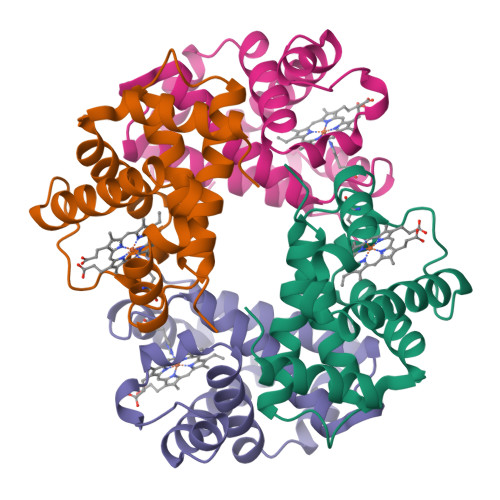
Hemoglobin subunit beta
Homo sapiensTaxon: 9606
147
acides aminés
16.0 kDa
théorique
50
entrées PDB
4
enregistrées
Fonction
Localisation & Distribution
Spécificité Tissulaire
Red blood cells
Maladies Associées
Heinz body anemias
Form of non-spherocytic hemolytic anemia of Dacie type 1. After splenectomy, which has little benefit, basophilic inclusions called Heinz bodies are demonstrable in the erythrocytes. Before splenectomy, diffuse or punctate basophilia may be evident. Most of these cases are probably instances of hemoglobinopathy. The hemoglobin demonstrates heat lability. Heinz bodies are observed also with the Ivemark syndrome (asplenia with cardiovascular anomalies) and with glutathione peroxidase deficiency.
Beta-thalassemia
A form of thalassemia. Thalassemias are common monogenic diseases occurring mostly in Mediterranean and Southeast Asian populations. The hallmark of beta-thalassemia is an imbalance in globin-chain production in the adult HbA molecule. Absence of beta chain causes beta(0)-thalassemia, while reduced amounts of detectable beta globin causes beta(+)-thalassemia. In the severe forms of beta-thalassemia, the excess alpha globin chains accumulate in the developing erythroid precursors in the marrow. Their deposition leads to a vast increase in erythroid apoptosis that in turn causes ineffective erythropoiesis and severe microcytic hypochromic anemia. Clinically, beta-thalassemia is divided into thalassemia major which is transfusion dependent, thalassemia intermedia (of intermediate severity), and thalassemia minor that is asymptomatic.
Sickle cell disease
Characterized by abnormally shaped red cells resulting in chronic anemia and periodic episodes of pain, serious infections and damage to vital organs. Normal red blood cells are round and flexible and flow easily through blood vessels, but in sickle cell anemia, the abnormal hemoglobin (called Hb S) causes red blood cells to become stiff. They are C-shaped and resemble a sickle. These stiffer red blood cells can lead to microvascular occlusion thus cutting off the blood supply to nearby tissues.
Beta-thalassemia, dominant, inclusion body type
An autosomal dominant form of beta thalassemia characterized by moderate anemia, lifelong jaundice, cholelithiasis and splenomegaly, marked morphologic changes in the red cells, erythroid hyperplasia of the bone marrow with increased numbers of multinucleate red cell precursors, and the presence of large inclusion bodies in the normoblasts, both in the marrow and in the peripheral blood after splenectomy.
Séquence d'Acides Aminés
MVHLTPEEKSAVTALWGKVNVDEVGGEALGRLLVVYPWTQRFFESFGDLSTPDAVMGNPK
VKAHGKKVLGAFSDGLAHLDNLKGTFATLSELHCDKLHVDPENFRLLGNVLVCVLAHHFG
KEFTPPVQAAYQKVVAGVANALAHKYH
Format FASTA · 147 acides aminés · masse 16.0 kDa
Structures Expérimentales
50 entrées PDBModifications Post-Traductionnelles
- •Glucose reacts non-enzymatically with the N-terminus of the beta chain to form a stable ketoamine linkage. This takes place slowly and continuously throughout the 120-day life span of the red blood cell. The rate of glycation is increased in patients with diabetes mellitus
- •S-nitrosylated; a nitric oxide group is first bound to Fe(2+) and then transferred to Cys-94 to allow capture of O(2)
- •Acetylated on Lys-60, Lys-83 and Lys-145 upon aspirin exposure