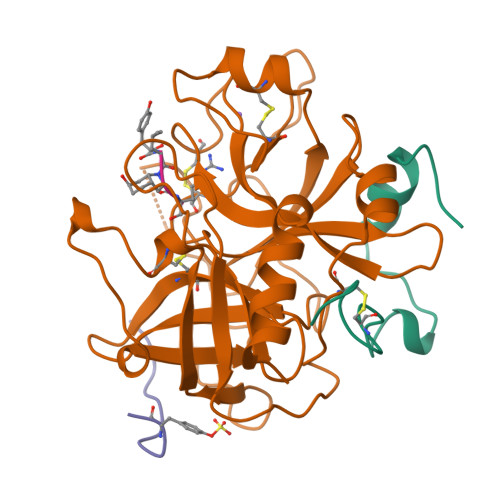
Prothrombin
Homo sapiensTaxon: 9606
622
amino acids
70.0 kDa
theoretical
50
PDB entries
4
recorded
Function
Localization & Distribution
Tissue Specificity
Expressed by the liver and secreted in plasma
Related Diseases
Factor II deficiency
A very rare blood coagulation disorder characterized by mucocutaneous bleeding symptoms. The severity of the bleeding manifestations correlates with blood factor II levels.
Ischemic stroke
A stroke is an acute neurologic event leading to death of neural tissue of the brain and resulting in loss of motor, sensory and/or cognitive function. Ischemic strokes, resulting from vascular occlusion, is considered to be a highly complex disease consisting of a group of heterogeneous disorders with multiple genetic and environmental risk factors.
Thrombophilia due to thrombin defect
A multifactorial disorder of hemostasis characterized by abnormal platelet aggregation in response to various agents and recurrent thrombi formation.
Pregnancy loss, recurrent, 2
A common complication of pregnancy, resulting in spontaneous abortion before the fetus has reached viability. The term includes all miscarriages from the time of conception until 24 weeks of gestation. Recurrent pregnancy loss is defined as 3 or more consecutive spontaneous abortions.
Amino Acid Sequence
MAHVRGLQLPGCLALAALCSLVHSQHVFLAPQQARSLLQRVRRANTFLEEVRKGNLEREC
VEETCSYEEAFEALESSTATDVFWAKYTACETARTPRDKLAACLEGNCAEGLGTNYRGHV
NITRSGIECQLWRSRYPHKPEINSTTHPGADLQENFCRNPDSSTTGPWCYTTDPTVRRQE
CSIPVCGQDQVTVAMTPRSEGSSVNLSPPLEQCVPDRGQQYQGRLAVTTHGLPCLAWASA
FASTA format · 622 amino acids · mass 70.0 kDa
Experimental Structures
50 PDB entriesPost-Translational Modifications
- •The gamma-carboxyglutamyl residues, which bind calcium ions, result from the carboxylation of glutamyl residues by a microsomal enzyme, the vitamin K-dependent carboxylase. The modified residues are necessary for the calcium-dependent interaction with a negatively charged phospholipid surface, which is essential for the conversion of prothrombin to thrombin
- •N-glycosylated. N-glycan heterogeneity at Asn-121: Hex3HexNAc3 (minor), Hex4HexNAc3 (minor) and Hex5HexNAc4 (major). At Asn-143: Hex4HexNAc3 (minor) and Hex5HexNAc4 (major)
- •In the penultimate step of the coagulation cascade, prothrombin is converted to thrombin by the prothrombinase complex composed of factor Xa (F10), cofactor Va (F5), and phospholipids. This activation requires factor Xa-catalyzed sequential cleavage at 2 sites, Arg-314 and Arg-363, along 2 possible pathways. In the first pathway, the first cleavage occurs at Arg-314, leading to the formation of the inactive intermediate prethrombin-2. This pathway preferentially occurs on platelets and in the absence of cofactor Va. In the second pathway, the first cleavage occurs at Arg-363, which separates protease domain into 2 chains that remain connected through a disulfide bond and generates the active intermediate meizothrombin. The presence of cofactor Va directs activation along the meizothrombin pathway and greatly accelerates the rate of cleavage at Arg-363, but has a smaller effect on the cleavage of meizothrombin at Arg-314. Meizothrombin accumulates as an intermediate when prothrombinase is assembled on the membrane of red blood cells