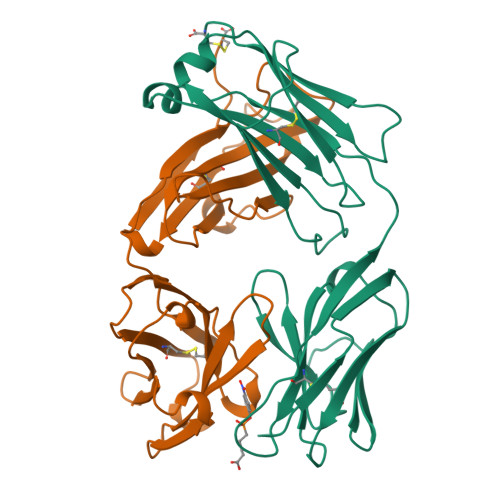
Immunoglobulin heavy constant gamma 1
免疫球蛋白重常数 γ 1
Homo sapiensTaxon: 9606
399
amino acids
43.9 kDa
theoretical
50
PDB entries
1
recorded
Function
Related Diseases
Multiple myeloma
A malignant tumor of plasma cells usually arising in the bone marrow and characterized by diffuse involvement of the skeletal system, hyperglobulinemia, Bence-Jones proteinuria and anemia. Complications of multiple myeloma are bone pain, hypercalcemia, renal failure and spinal cord compression. The aberrant antibodies that are produced lead to impaired humoral immunity and patients have a high prevalence of infection. Amyloidosis may develop in some patients. Multiple myeloma is part of a spectrum of diseases ranging from monoclonal gammopathy of unknown significance (MGUS) to plasma cell leukemia.
Amino Acid Sequence
ASTKGPSVFPLAPSSKSTSGGTAALGCLVKDYFPEPVTVSWNSGALTSGVHTFPAVLQSS
GLYSLSSVVTVPSSSLGTQTYICNVNHKPSNTKVDKKVEPKSCDKTHTCPPCPAPELLGG
PSVFLFPPKPKDTLMISRTPEVTCVVVDVSHEDPEVKFNWYVDGVEVHNAKTKPREEQYN
STYRVVSVLTVLHQDWLNGKEYKCKVSNKALPAPIEKTISKAKGQPREPQVYTLPPSRDE
FASTA format · 399 amino acids · mass 43.9 kDa
Experimental Structures
50 PDB entriesPost-Translational Modifications
- •N-glycosylated. Carries predominantly biantennary complex-type glycans attached at Asn-180 residue on the Fc region of each heavy chain. Unique Fc glycan profiles found in secreted IgGs are induced in an antigen-specific way, likely programmed during B cell priming to mount an appropriate Ig effector response (PubMed:10818239, PubMed:10917521, PubMed:21768335, PubMed:22184099, PubMed:25561553, PubMed:29133956, PubMed:29445378). The core glycan is composed of two sequential N-acetylglucosamine (GlcNAc) moieties followed by a central mannose (Man) from which two additional Man residues branch out (alpha1,3 and alpha1,6 antennae) each capped with a GlcNAc. Additional sugar molecules can be added to generate over 30 possible glycans. Such sugar modifications include the addition of one fucose at the initial GlcNAc, galactose (Gal) and sialic acid (Neu5Ac) residues at antennary GlcNAc or a bisecting GlcNAc to the core Man (PubMed:10818239, PubMed:22184099, PubMed:29133956, PubMed:38383719). Variable addition of sugars account for different IgG functional states associated with antibody-dependent cellular cytotoxicity or phagocytosis and inflammatory responses such as complement activation and cytokine secretion. Fc N-glycan diversity is further enhanced by asymmetric glycan pairing on the heavy chains (PubMed:10818239, PubMed:20357243, PubMed:22184099, PubMed:29133956). Fc N-glycan sialylation is linked to anti-inflammatory effects. It regulates Fc effector functions through conformational changes leading to preferential interaction with type II Fc receptors while reducing binding to type I Fc receptors. During plasmablast response, sialylated Fc domains within immune complexes signal via FCER2/CD23 and drive the selection of B cells with high affinity for antigen (PubMed:18420934, PubMed:22184099, PubMed:25733881, PubMed:26140596). Fc Igs carrying afucosylated N-glycans preferentially activate FCGR3A, antigen-dependent cellular cytotoxicity and antitumor immunity (PubMed:12427744, PubMed:21768335, PubMed:28566370, PubMed:30061887, PubMed:36867679)
- •(Microbial infection) Deglycosylation on Asn-180 by S. pyogenes EndoS or Endos2 endoglucosidases prevents interaction between immunoglobulin-gamma (IgG) and Fc receptors, impairing ability to activate the complement pathway