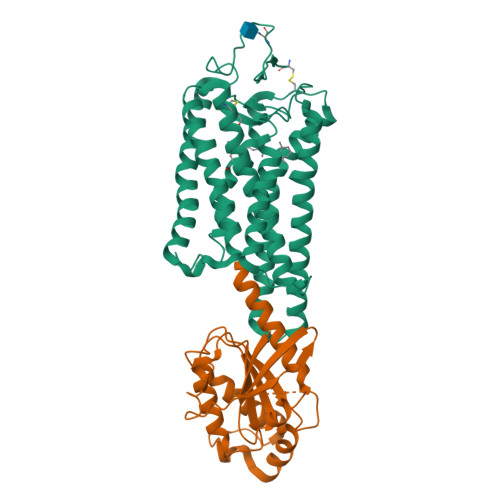
Guanine nucleotide-binding protein G(o) subunit alpha structure
P09471
GNAO_HUMAN
GNAO1

Guanine nucleotide-binding protein G(o) subunit alpha

Homo sapiensTaxon: 9606

3D-structureADP-ribosylationAlternative splicingCell membraneDisease variantEpilepsyGTP-bindingHydrolaseLipoproteinMagnesiumMembraneMetal-binding+6
配列長

354

アミノ酸

分子量

40.1 kDa

理論値

実験構造

50

PDB エントリー

関連疾患

2

記録済み

機能記述

Guanine nucleotide-binding proteins (G proteins) function as transducers downstream of G protein-coupled receptors (GPCRs) in numerous signaling cascades (PubMed:29925951, PubMed:33408414). The alpha chain contains the guanine nucleotide binding site and alternates between an active, GTP-bound state and an inactive, GDP-bound state (By similarity). Signaling by an activated GPCR promotes GDP release and GTP binding (By similarity). The alpha subunit has a low GTPase activity that converts bound GTP to GDP, thereby terminating the signal (By similarity). Both GDP release and GTP hydrolysis are modulated by numerous regulatory proteins (By similarity). Signaling is mediated via effector proteins, such as adenylate cyclase (By similarity). Inhibits adenylate cyclase activity, leading to decreased intracellular cAMP levels (By similarity)
鸟嘌呤核苷酸结合蛋白 (G 蛋白) 在众多信号级联中充当 G 蛋白偶联受体 (GPCR) 下游的转导子 (PubMed:29925951、PubMed:33408414)。 α 链包含鸟嘌呤核苷酸结合位点,并在活性、GTP 结合状态和非活性、GDP 结合状态之间交替(通过相似性)。 激活的 GPCR 发出的信号会促进 GDP 释放和 GTP 结合(通过相似性)。 α 亚基具有低 GTP 酶活性,可将结合的 GTP 转化为 GDP,从而终止信号(通过相似性)。 GDP 释放和 GTP 水解均受众多调节蛋白的调节(通过相似性)。 信号传导通过效应蛋白介导,例如腺苷酸环化酶(通过相似性)。 抑制腺苷酸环化酶活性,导致细胞内 cAMP 水平降低(通过相似性)
您所阅读的中文介绍为AI翻译机制自动翻译,并未经过人工审核,如有错漏,请以英文原文为准!

関連疾患

Developmental and epileptic encephalopathy 17

A severe neurologic disorder characterized by onset of intractable seizures in the first weeks or months of life and usually associated with EEG abnormalities. Affected infants have very poor psychomotor development and may have brain abnormalities, such as cerebral atrophy or thin corpus callosum. Some patients may show involuntary movements.

Neurodevelopmental disorder with involuntary movements

A neurodevelopmental disorder manifesting with a wide range of clinical symptoms. Clinical features range from severe motor and cognitive impairment with marked choreoathetosis, self-injurious behavior and epileptic encephalopathy, to a milder phenotype featuring moderate developmental delay associated with complex stereotypies, mainly facial dyskinesia, and mild epilepsy. Hyperkinetic movements are often exacerbated by specific triggers, such as illness, emotion and high ambient temperature. Some patients have brain abnormalities, such as cerebral atrophy or thin corpus callosum.

アミノ酸配列

MGCTLSAEERAALERSKAIEKNLKEDGISAAKDVKLLLLGAGESGKSTIVKQMKIIHEDG
FSGEDVKQYKPVVYSNTIQSLAAIVRAMDTLGIEYGDKERKADAKMVCDVVSRMEDTEPF
SAELLSAMMRLWGDSGIQECFNRSREYQLNDSAKYYLDSLDRIGAADYQPTEQDILRTRV
KTTGIVETHFTFKNLHFRLFDVGGQRSERKKWIHCFEDVTAIIFCVALSGYDQVLHEDET

FASTA 形式 · 354 アミノ酸 · 分子量 40.1 kDa

実験構造

50 PDB エントリー
6FUF6G796K416OIK6WWZ7D767D777EJ07EJ87EJA7EJK7QVM7T8X7T907T947T967W2Z7W6P7W7E7XJJ7Y248DZQ8E9X8FN18HPT8HQC8I958I978I9L8I9S8IA28IEC8IED8IY98IYH8IYW8J6D8JER8JHN8JZP8JZZ8TZQ8U028XWV8XX38XX68XX78XXH8XXR8XXX

翻訳後修飾

  • Histaminylated at Gln-205 residues by TGM2
  • Palmitoylated at Cys-351, leading to binding to ADGRG3